You Won’t Believe These Hidden Public Spaces in Ho Chi Minh City
Ho Chi Minh City isn’t just motorbikes and street food—it’s alive with vibrant public spaces most travelers completely miss. I wandered beyond the tourist trails and discovered parks, plazas, and cultural hubs where locals laugh, exercise, and connect. These spots reveal the city’s soul in ways no temple or market ever could. If you want to *feel* the real Saigon, this is where to start. The rhythm of daily life pulses strongest not in museums or shopping malls, but in open-air squares, leafy parks, and pedestrian pathways where generations gather, traditions unfold, and community thrives. This is a city that lives outside its walls, where even the busiest intersections give way to spaces of rest, reflection, and human connection. To understand Ho Chi Minh City fully, one must step off the sidewalk and into its shared heart.
The Pulse of the City: Why Public Spaces Matter in Ho Chi Minh City
In a metropolis of over nine million people, public spaces serve as essential lungs—areas where the city can breathe, and its residents can reconnect with each other and themselves. Ho Chi Minh City, often perceived for its relentless pace and dense traffic, reveals a quieter, more harmonious side in its parks, plazas, and pedestrian zones. These shared environments are not mere decorative additions to urban life; they are vital components of social well-being and cultural continuity. From early morning until late evening, these spaces host a continuous flow of activity—elderly couples practicing tai chi, students reading under trees, children chasing bubbles, and friends sipping coffee on benches. Each gesture, each routine, reflects a deep-rooted Vietnamese value: the importance of community.
What makes these public areas so significant is their accessibility. Unlike private clubs or commercial centers, they are open to all, regardless of age, income, or background. A retired teacher might practice qigong beside a young office worker on a lunch break. A street vendor sets up near a fountain where families gather on weekends. These interactions, though often wordless, reinforce a sense of belonging and shared identity. In Vietnam, communal living has long been a cornerstone of village life, and even in the modern cityscape, that spirit endures. Public spaces become extensions of the extended family—places where people care for one another through small acts of presence and respect.
For travelers, understanding these dynamics offers a richer, more meaningful experience. Instead of merely ticking off famous landmarks, visitors who spend time in public areas begin to see the city as locals do—not as a series of attractions, but as a living, breathing organism. They witness how tradition and modernity coexist: a woman in traditional áo dài meditating near a group of teenagers dancing to K-pop music. These contrasts are not clashes but harmonies, carefully balanced in the everyday choreography of urban life. By observing and respectfully participating, travelers gain insight into the values that shape Vietnamese society—modesty, resilience, and warmth.
Tao Dan Park: Where Nature Meets the Urban Beat
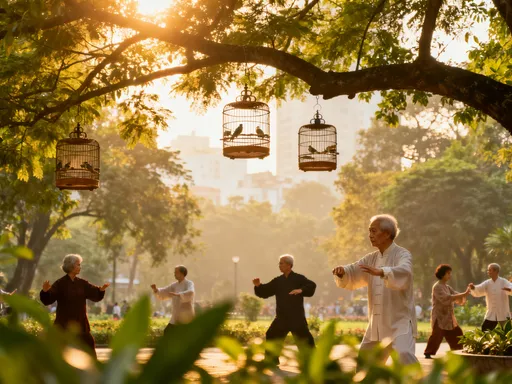
At the center of District 1 lies Tao Dan Park, a sprawling 20-acre green oasis that has served as Ho Chi Minh City’s most beloved urban park since the French colonial era. Towering rain trees form a natural canopy, filtering sunlight into dappled patterns on winding pathways. The air hums with birdsong—not from wild species, but from dozens of intricately crafted birdcages hanging from branches, each home to a songbird meticulously cared for by local enthusiasts. Every morning, clusters of seniors gather in clearings to practice tai chi, their movements slow and deliberate, synchronized like a silent dance. Nearby, groups perform traditional Vietnamese calisthenics, often accompanied by soft folk music played from portable speakers.
Families flock here on weekends, spreading mats under shady trees for picnics or watching children play on modest playground equipment. Couples stroll hand-in-hand along the central promenade, pausing to take photos beside lotus ponds where koi fish glide beneath lily pads. What makes Tao Dan Park special is not just its size or greenery, but its role as a true social hub. It is equally a place of solitude and community—one can sit quietly with a book or join a circle of strangers clapping along to a live accordion performance. Street vendors circulate with trays of coconut water, iced coffee, and grilled corn, offering refreshments without disrupting the park’s peaceful atmosphere.
Visitors are encouraged to come early in the morning, ideally between 6:00 and 8:00 a.m., to witness the park at its most vibrant and least crowded. This is when the energy is purest—filled with intention and calm rather than tourism. Respectful behavior is key: avoid loud conversations, refrain from feeding animals unless permitted, and never touch or disturb the birdcages. Photography is welcome, but it’s best to ask before taking close-up portraits of individuals. Tao Dan Park does not charge an entrance fee, and its gates remain open from dawn to dusk. For those seeking a moment of serenity amid the city’s chaos, this park offers a gentle reminder that nature and humanity can thrive together.
Nguyen Hue Walking Street: The Heartbeat of Modern Saigon
Just a short walk from Tao Dan Park, Nguyen Hue Walking Street stands as a bold expression of Ho Chi Minh City’s contemporary spirit. This 700-meter-long pedestrian boulevard stretches from the Saigon River to the City Hall, transformed in 2015 into a vibrant public space designed for leisure, celebration, and connection. Lined with tropical flowers, manicured hedges, and synchronized fountains, the street pulses with energy, especially on weekends and holidays. At night, colorful LED lights illuminate the walkway, reflecting off water jets that dance to music during scheduled shows. Street performers—magicians, musicians, breakdancers—draw crowds, while families glide by on rented bicycles or pause for selfies against light installations.
The significance of Nguyen Hue Boulevard extends beyond aesthetics. It represents a shift in urban planning toward prioritizing people over vehicles—a rare but growing trend in Southeast Asian megacities. During Tet (Lunar New Year), the street becomes the epicenter of festivities, adorned with towering flower sculptures and lantern displays that attract thousands nightly. Even on ordinary evenings, it remains a favorite spot for locals to unwind after work, walk with loved ones, or simply sit on elevated platforms and watch the city breathe. Benches are plentiful, and small kiosks sell fresh juice, grilled skewers, and sweet desserts, making it easy to linger.
To experience Nguyen Hue like a local, visit between 6:30 and 9:00 p.m., when the temperature cools and the lights come alive. Avoid midday visits, as the lack of shade can make walking uncomfortable. While the area is safe and well-patrolled, it’s wise to keep personal belongings secure in crowded conditions. Travelers should also note that drones are not permitted without official permission, and loud speakers or disruptive behavior are discouraged. The walking street connects seamlessly with other attractions—Don’t miss the rooftop observation deck at the Ho Chi Minh City People’s Committee Building (City Hall), which offers panoramic views, especially stunning at night. This space proves that modernity and public joy can coexist beautifully.
Saigon Central Post Office Courtyard: History in the Open Air
While most visitors rush inside the grand Saigon Central Post Office to admire its arched ceilings and vintage telephones, few take time to appreciate the quiet courtyard just outside. This open area, bordered by colonial-era architecture and shaded by wide-canopied trees, functions as an informal gathering spot where history and daily life converge. Tourists pause here to catch their breath, review maps, or wait for companions, while local students often sit on low walls sketching the building’s intricate façade. Street vendors hover nearby, offering iced coffee in plastic cups or postcards printed with vintage cityscapes, creating a gentle commerce that enhances rather than overwhelms the space.
The courtyard’s design reflects French urban principles—orderly, symmetrical, and dignified—yet it has been fully embraced by Vietnamese daily rhythms. Elderly men play chess on foldable boards, their moves slow and thoughtful. Couples sit close on benches, speaking in hushed tones. On weekends, families use the area as a meeting point before exploring nearby attractions like the Notre-Dame Cathedral Basilica of Saigon, now known as the Cathedral of Our Lady of Peace. The lack of formal programming—no fountains, no performances—makes this space feel authentic, almost accidental in its charm. It is not designed for spectacle, but for presence.
What makes this location powerful is its ability to ground visitors in time. Standing in the courtyard, one can imagine postal workers from the 1890s walking the same path, carrying letters across French Indochina. Today, the same space hosts digital nomads checking emails on phones, yet the sense of connection—of messages being sent and received—remains. For travelers, sitting here for even ten minutes offers a moment of reflection amid the city’s rush. The best times to visit are weekday mornings, when crowds are lighter and the morning light bathes the yellow façade in a warm glow. No admission fee or reservation is required—just respectful observation and quiet appreciation.
Lam Son Square and the Opera House: Elegance in Public Life
Nestled between Dong Khoi Street and the Saigon River, Lam Son Square is a graceful public plaza anchored by the stunning Municipal Theatre, commonly known as the Saigon Opera House. Built in 1897 during the French colonial period, this European-style opera house features pink façades, Corinthian columns, and a mansard roof, standing as a testament to architectural elegance in a tropical climate. The surrounding square, though compact, is meticulously maintained, with symmetrical flowerbeds, palm trees, and stone pathways that invite slow strolls. Unlike many historic sites locked behind velvet ropes, this space remains fully accessible, used daily by locals for walks, photography, and quiet contemplation.
Evenings are particularly enchanting. As the sun sets, golden lights illuminate the opera house, casting soft reflections on the wet pavement after a brief rain. Couples pose for engagement photos against the grand staircase, while tourists snap pictures from the opposite side of the square. Yet, despite its popularity, the atmosphere remains calm—almost reverent. There are no loud vendors or aggressive touts, just the occasional coffee cart and the distant hum of passing cyclos. The square hosts occasional cultural events, such as open-air piano performances or holiday light displays, further enriching its role as a living cultural venue.
What makes Lam Son Square remarkable is how seamlessly it integrates European design with Vietnamese urban life. The formality of its layout contrasts beautifully with the ease of its use—children run freely across the open space, elders meditate on benches, and artists sketch the façade with charcoal pencils. It is a place where heritage is not preserved in isolation, but lived in and through. For visitors, combining a visit here with a coffee at one of Dong Khoi’s heritage cafés—many housed in century-old villas—creates a deeper sense of time and continuity. The square reminds us that beauty, when shared, becomes even more powerful.
Hidden Neighborhood Plazas: Off-the-Beaten-Path Moments
Beyond the well-trodden paths of District 1, quieter public spaces offer an even more intimate look at Saigon’s soul. In District 3, a short ride from the city center, small neighborhood plazas and pocket parks reveal the rhythms of everyday life. One such space, near the intersection of Vo Van Tan and Nam Ky Khoi Nghia, features a shaded playground, outdoor fitness equipment, and a circular bench where retirees gather each morning. Chessboards are permanently embedded in stone tables, always in use. After school, children flood the area, swinging, sliding, and laughing without self-consciousness. These spaces are unassuming—no grand architecture, no tourist brochures—but they pulse with authenticity.
Pham Ngu Lao, often associated with budget hostels and backpacker bars, also hides small communal areas where locals reclaim their neighborhood. A tucked-away courtyard near a community center hosts tai chi classes at dawn, while a narrow park along a canal serves as a quiet escape for office workers on lunch breaks. These spots are not designed for visitors, which is precisely what makes them valuable. They are spaces of unperformed life, where people behave naturally because no one is watching. For the observant traveler, these places offer rare moments of connection—not through interaction, but through witness.
Exploring these lesser-known areas requires a shift in mindset. Instead of rushing from one landmark to the next, travelers are invited to wander without a destination, to turn down side streets and notice how people use space. A simple bench under a tree might host a grandmother feeding pigeons. A vacant lot could be transformed into an impromptu badminton court. These are not attractions to be checked off, but experiences to be absorbed. Safety is generally high in these districts, especially during daylight hours, and locals are often curious but respectful of quiet observers. Wearing modest clothing and moving at a relaxed pace helps blend in. The reward is not a photo, but a feeling—that of being present in the real Saigon.
How to Experience Public Spaces Like a Local: Practical Tips
To truly connect with Ho Chi Minh City’s public spaces, travelers should adopt a few simple practices. First, slow down. These areas are not meant to be rushed through, but lingered in. Arrive early in the morning to witness tai chi sessions or evening strolls as the city cools. Second, observe before participating. Watch how locals behave—how they greet each other, where they sit, how they interact with vendors. Respectful observation is often more meaningful than forced engagement. Third, support the informal economy. Buy a coffee from a street vendor, purchase a snack from a woman with a tray, or rent a bicycle for a spin along Nguyen Hue. These small acts create invisible bridges between visitor and resident.
Timing is crucial. Midday heat, especially from 11 a.m. to 3 p.m., makes outdoor spaces uncomfortable. Early mornings and late afternoons offer the best conditions for exploration. Dress in lightweight, breathable clothing and carry water. While most public areas are safe, it’s wise to keep valuables secure and avoid displaying expensive electronics. Photography is generally welcomed, but always ask before taking photos of people, especially the elderly or children. Flash photography during performances or quiet moments should be avoided.
Consider combining visits to public spaces with nearby cultural sites. A morning at Tao Dan Park can be followed by a visit to the War Remnants Museum, while an evening on Nguyen Hue Walking Street pairs well with dinner at a rooftop restaurant overlooking the river. Use public transportation or walk when possible—this not only reduces environmental impact but increases immersion. Most importantly, approach these spaces with humility and curiosity. You are a guest in someone’s daily life. A smile, a nod, a quiet presence—these small gestures often speak louder than words.
These public spaces aren’t just places on a map—they’re living stages where Ho Chi Minh City performs its daily rhythm. By stepping into them, travelers gain more than photos; they gain connection. The real Saigon isn’t rushed. It breathes in parks, laughs in plazas, and lives in the open air. To see it, all you need to do is walk, pause, and look around.